
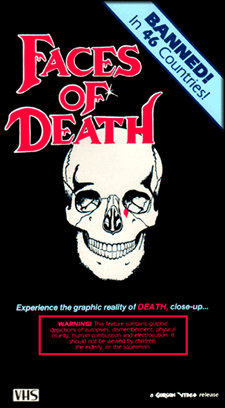
Possibly one of the most talked about series of all time, Faces of Death examines the many guises of death in the extreme close-up. Sure to
shock , horrify and even repulse, these brutal films are not meant for
the faint of heart.
Faces of
Death: VOLUME I - Features a vicious pit bull fight, the clubbing of
baby seals, monkey brains, a man setting himself on fire, an electrocution,
San Francisco cultists dining on human organs, a suicidal jumper taking
his final leap, a visit to a slaughter house, an alligator attack, and
a visit to an autopsy room.

"During the past 20 years I know that my compulsion to understand death was much greater than just
an obsession. My dreams had dictated my mission
and now it is time to witness the final moment, to discover a circle that forever repeats itself.
The end of the beginning or the beginning of the end, I'll leave that decision up to you."
- Dr. Francis B. Gross |

The crucial work that bridges the gap between classic Mondo cinema and the next generation of death films, Faces of Death was perhaps the first (and certainly most notorious) shockumentary to focus exclusively on death. Its premise is to showcase a supposedly educational kaleidoscope of the various forms, or “faces,” of death that take place in the world, and naturally, such a claim allows the filmmakers hide behind the mask of legitimacy. Although Faces of Death is far less exploitative and insulting than its successor series Traces of Death and Faces of Gore, its true colors as exploitation bosh are all too apparent.
The influence of Antonio Climati’s Savage Man Savage Beast is impossible to miss, as John Alan Schwartz (billed as Conan le Cilaire) mimics the far-superior Mondo classic every chance he gets. The pathetically staged bear attack in an unnamed national park is a recreation of the infamous death of Pit Dernitz from Savage Man Savage Beast, and Climati’s classic use of cinéma vérité is also utilized by Schwartz in a desperate attempt to conceal all aspects that may expose his setup. Although the death scenes from Savage Man Savage Beast are also staged, Climati’s lifelong cinematographic training adds a professional edge to the deception. In Faces of Death, the efforts to replicate these tactics are laughably bad, and only the most trusting individuals will believe the scenes are genuine. Also, Climati’s wise decision not to include sound while working with amateur actors is ignored by Schwartz, as the pathetic dialogue and delivery help to destroy any leftover credibility.
Undoubtedly, some scenes are genuine examples of death, and though the narration gives a decent effort to handle the material delicately, other crass aspects shatter the illusion of any serious attempt to educate the viewer. Comic relief that is inserted into the scenes becomes inane and offensive instead of serving its purpose. For instance, a rather bloated version of “Old MacDonald” plays while a chicken is beheaded, and voiceover excitedly counts down, “One, two, one, two, three, four!” before a suicide jumper hurls herself from a window. Schwartz’s rather inept portrayal of a truly concerned medical professional doesn’t help matters.
Since such genuine death scenes are obviously accessible, one must wonder why Schwartz decided to include staged footage if his intentions were truly noble. Indeed, the staged scenes serve as examples of each death they depict, yet they also happen to be the most exploitative sequences had they been genuine. This is no coincidence; Schwartz chose to stage the most exploitative examples he could imagine in order to draw an audience, which also proves that the film is intended merely as another exploitation showcase. Although the same can be said for all Mondo films (Climati’s Savage Man Savage Beast is often labeled similarly), classic Mondo cinema is able to mask its exploitation much more competently, refrains from mocking the victims, and retains some respectability through technical prowess. All these aspects are absent from Faces of Death.
The film’s final plague is that it is inherently boring. The blame doesn’t lie with the film itself as much as with Schwartz’s decision to partake in Mondo cinema. Mondo serves as a showcase and often lacks a coherent narrative or argument. This has been true since Jacopetti revolutionized the kaleidoscopic strategy way back in Mondo cane. The problem with this direction is that even Mondo cane becomes rather tedious after a certain point, even though the film is technically marvelous and heralded as a cinematic breakthrough. The tedium of Faces of Death doesn’t result from the fact that it’s a bad film rather than it is unavoidable.
 Of course, Schwartz doesn’t get every aspect wrong. His decision not to mock the victims with his narration (although he can’t resist to include a few laughs at another’s expense) places his film several levels above the newer death films of the eighties and nineties, and the incredible influence of Faces of Death is undeniable. He should also be praised for shooting his own footage (even if it is staged) instead of lazily incorporating stock footage or stealing scenes from other films, to which the Mondo genre has since degenerated.
Despite this valiant effort to chase the heart of classic Mondo cinema, Schwartz’s lust for exploitation is too great to raise his film to higher Mondo quality. Make no mistake, I am admittedly an avid fan of exploitation and schlock cinema, but most exploitation is fictional garbage that never tries to be any more than such (except for Cannibal Holocaust, which transcends its boundaries brilliantly). Rather, it is Schwartz’s disingenuous approach and intentional failure to properly handle the subject matter that drags his film to lower standards.

 | |  | | 
 | |  | | 

- In
an interview, director John Alan Schwartz said that he played the leader
of the flesh eating cult at the end of the film.
- At
the end of the film, the credits say "Special thanks to the mummies of
Guanajuato, Mexico."
- The
drown swimmer that looks like a hippy was actually discovered by John Alan
Schwartz. He was swimming in the ocean four days before they were to shoot
the alligator sequence and he brushed up against something. It turned out
to be the hippy's body.
- Faces
of Death has been banned in over 46 countries!
- Director
John Alan Schwartz is listed in the Faces of Death credits
as Alan Black. Schwartz's middle name is Alan, and Schwarz means black
in German.
- Over
30 minutes were cut from the banned UK release.
- In
2003 scenes from Faces of Death were featured throughout Rob Zombie's House
of 1000 Corpses.
- Faces
of Death was intended as a Japanese-only release in 1979, but found
its way to the United States, and the national news, a couple of years
later.
- The
original Japanese title for Faces of Death was Junk.
- Director
John Alan Schwartz and a friend built/filmed the famous "electrocution
scene" in a local loft and used toothpaste for the foam effect. Schwartz
used an article from a Hustler magazine on electrocution as research material
on how to make the scene believable............ it worked.
- Once
a year, on Halloween, director John Alan Schwartz speaks at college campuses
about his adventures creating Faces of Death.
- To
date, the original Faces of Death has grossed over $30-million.
It cost $450,000 to make.
     



|